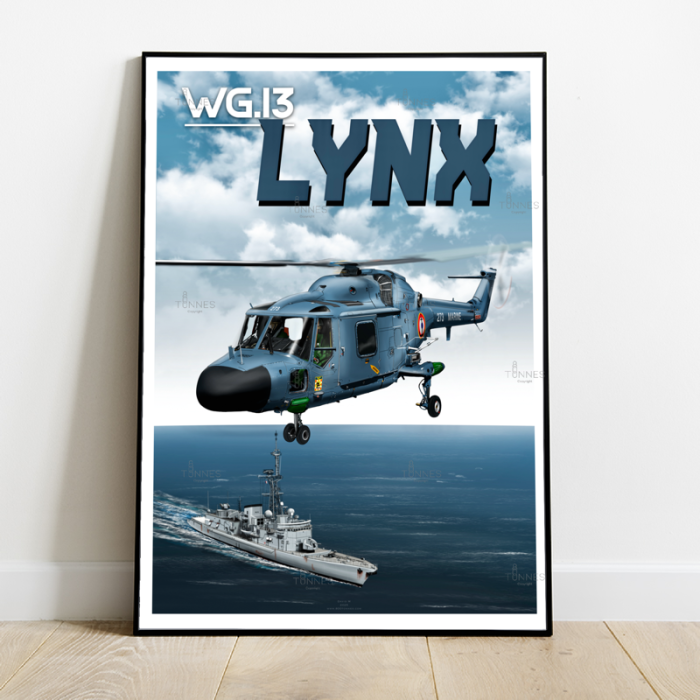





A poster of the WG.13 "Lynx", a transport and anti-submarine warfare helicopter.
Born from a collaboration between Westland Helicopters and Aérospatiale following an agreement signed in 1967, the Lynx made its first flight on March 21, 1971. Initially intended for civil and naval use, it quickly won over the military, becoming operational in 1977. Adopted by more than a dozen countries, it distinguished itself by its performance: in 1972, it broke speed records (321.74 km/h over 15 km).
Production and versions
The initial agreements called for 55 Lynxes for France and 190 for the United Kingdom, but 369 were ultimately built. The British Army ordered 100 Lynx AH Mk.1s, equipped for tactical transport, anti-tank warfare (TOW missiles), and reconnaissance. In France, the Lynx MK4 specializes in anti-submarine warfare, with a DUAV 4 sonar capable of analyzing water columns up to 100 m deep. It can launch Mark 46 torpedoes and perform 7 to 8 search cycles in 2 hours.
Versatility and Missions
Modular, the Lynx also fulfills roles in anti-ship warfare (FLIR camera, TITUS kit), commando operations (sniper embarkation, AANF-1 weapon), search and rescue (diver, stretcher), and logistics (VIP transport).
End of Service
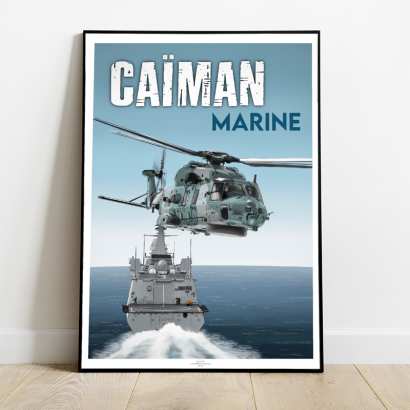
Replaced by the NH90 Caïman in the French Navy (withdrawn in 2020), it also gave way to the Wildcat (AW159) in the British forces from the 2010s.

Data sheet
| Dimensions | A2 (16,5 in × 23,4 in) |
|---|---|
| Paper | Matte 135 g/m² |
Specific References
No customer reviews for the moment.
A poster of the WG.13 "Lynx", a transport and anti-submarine warfare helicopter.