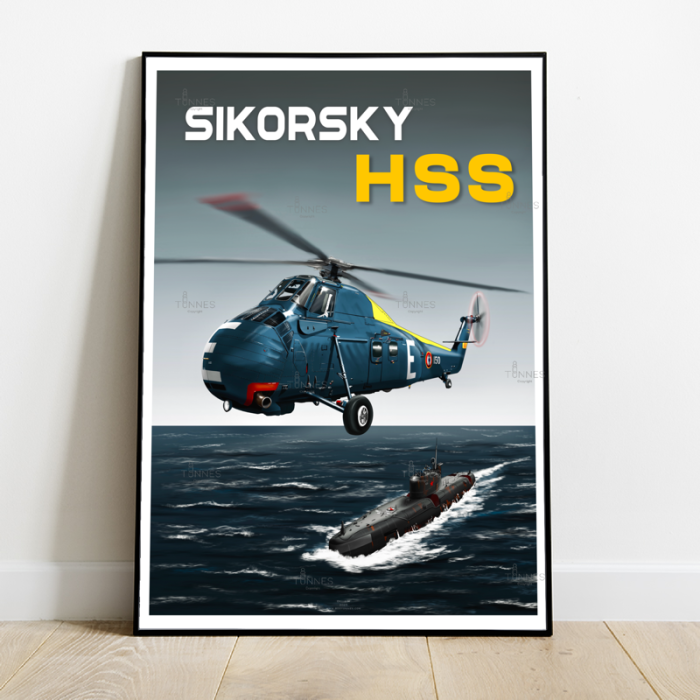




A poster of the Sikorsky HSS, a heavy anti-submarine warfare helicopter.
The history of French HSS helicopters began in 1957 with the arrival of the first American Sikorskys. Their operational adventure began in 1958 in Algeria, with the 32F flotilla based in Oran. Equipped with a 20mm cannon, the HSS helicopters supported troops, transported Marine Commandos, evacuated the wounded, and supplied combat zones.
The 31F, 32F, and 33F flotillas, grouped under GHAN1, collaborated closely with the Marine Commandos. In 1960, their effectiveness was celebrated during the official "helicopter-commando" twinning. Following the Evian Accords in 1962, the HSS helicopters left Algeria, accumulating more than 50,000 flight hours and transporting 110,000 Commandos. The 20S, a pioneer in anti-submarine warfare, tested the HSS with an American sonar as early as 1959. The HSS evolved visually: roundels reappeared, yellow colors, and marking letters. Only the 33F retained its original appearance.
In mainland France, the flotillas were based in Saint-Mandrier and Lanvéoc-Poulmic. The 32F participated in the trials of the helicopter carrier Jeanne d'Arc and regularly dispatched HSS units there until 1969. The 33F supported various regiments and operated in Chad, Tunisia, and the Indian Ocean.
The 1970s marked the end of the HSS: the 32F switched to the Super Frelon in 1970, followed by the 31F in 1978. The Jeanne d’Arc Section (SJA) was the last to use the HSS until 1979. On June 22, 1979, the 33F completed 20 years of HSS service, after 185,000 flight hours and 57 aircraft built.

Data sheet
| Dimensions | A2 (16,5 in × 23,4 in) |
|---|---|
| Paper | Matte 135 g/m² |
Specific References
No customer reviews for the moment.
A poster of the Sikorsky HSS, a heavy anti-submarine warfare helicopter.